
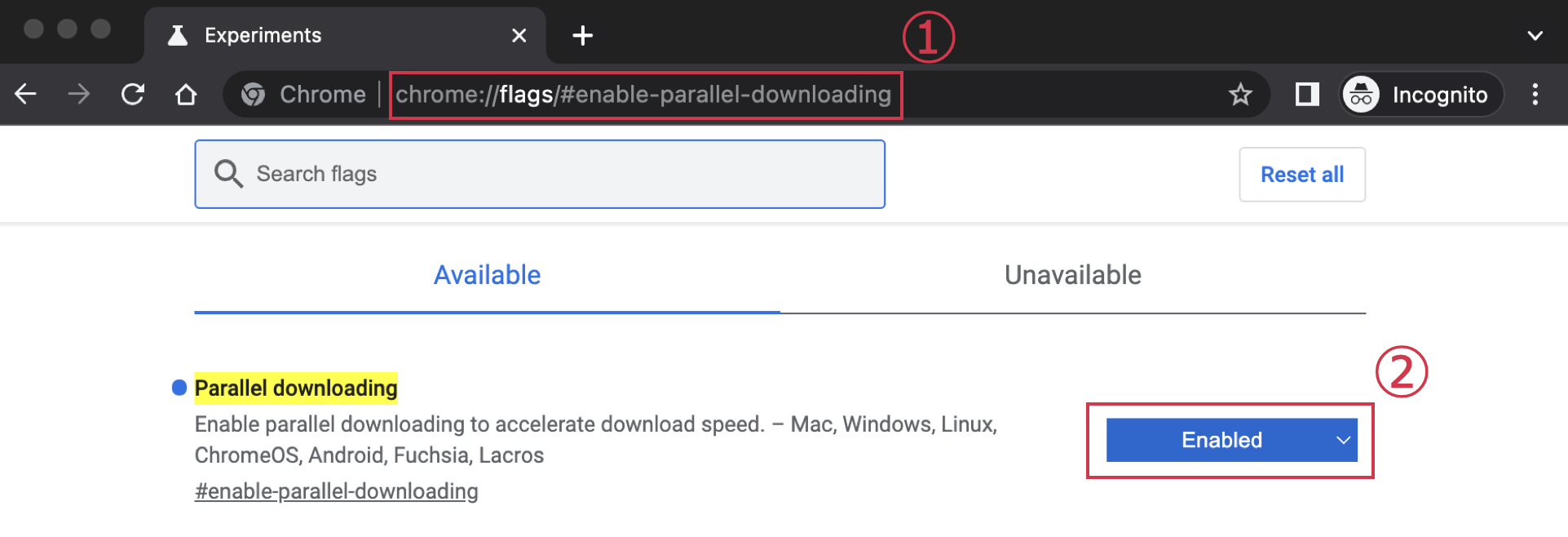
Acceleration of data loading
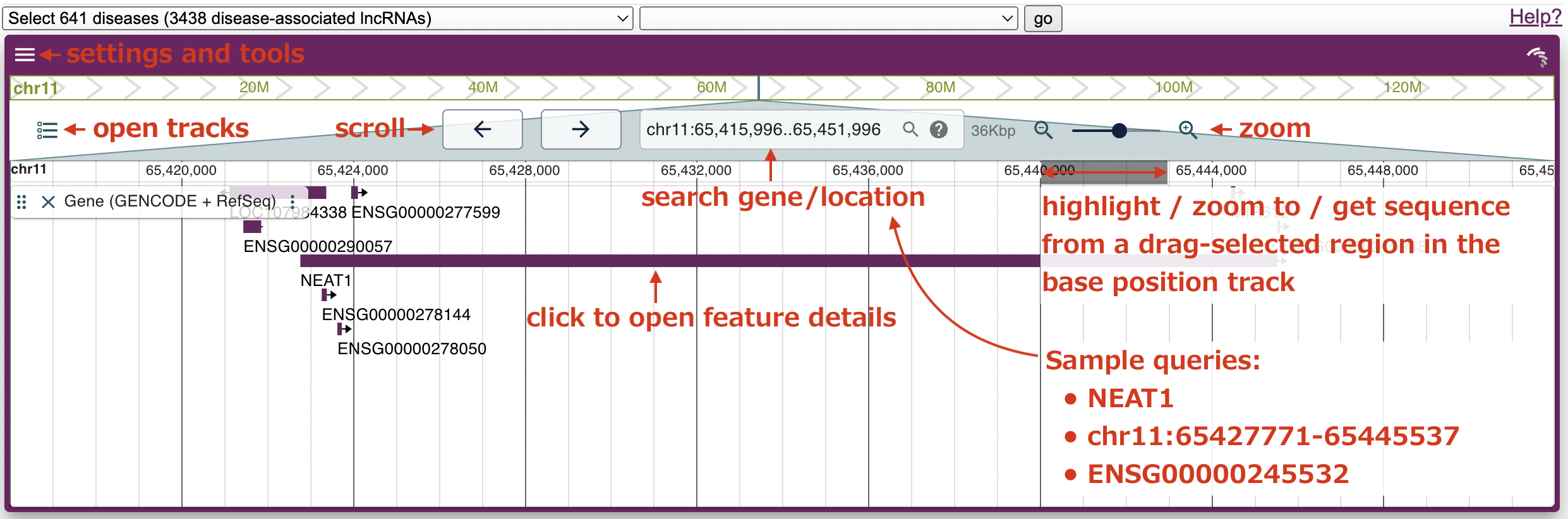
Basic usage
Specify a disease-associated lncRNA
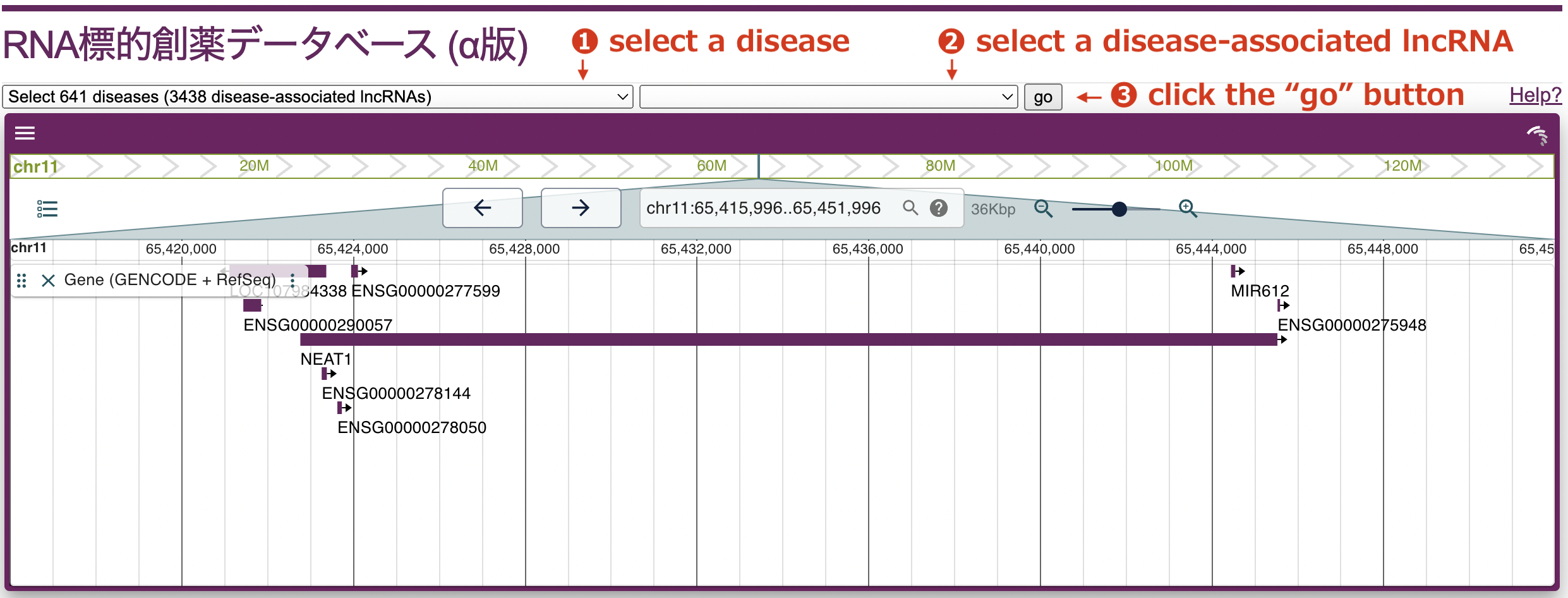
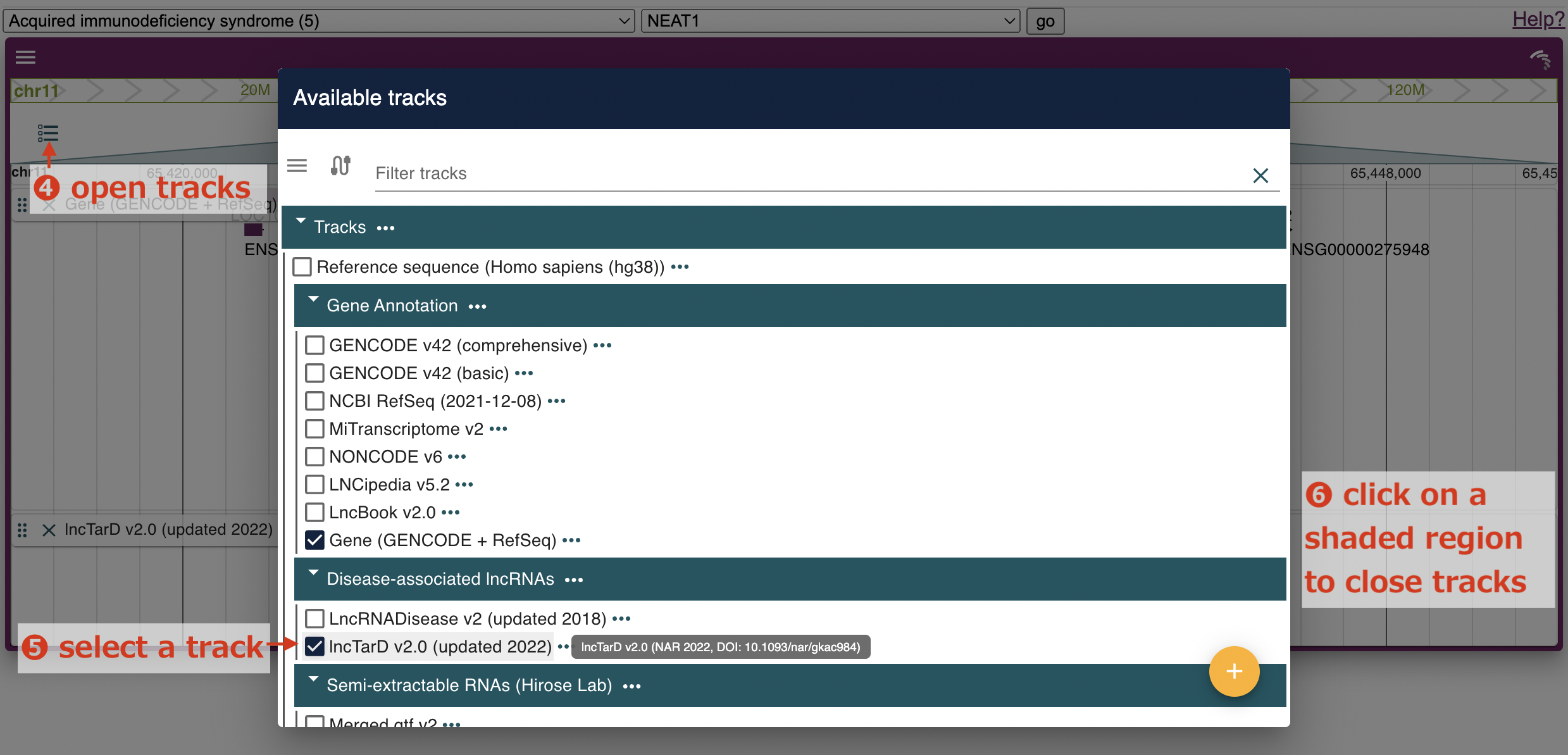
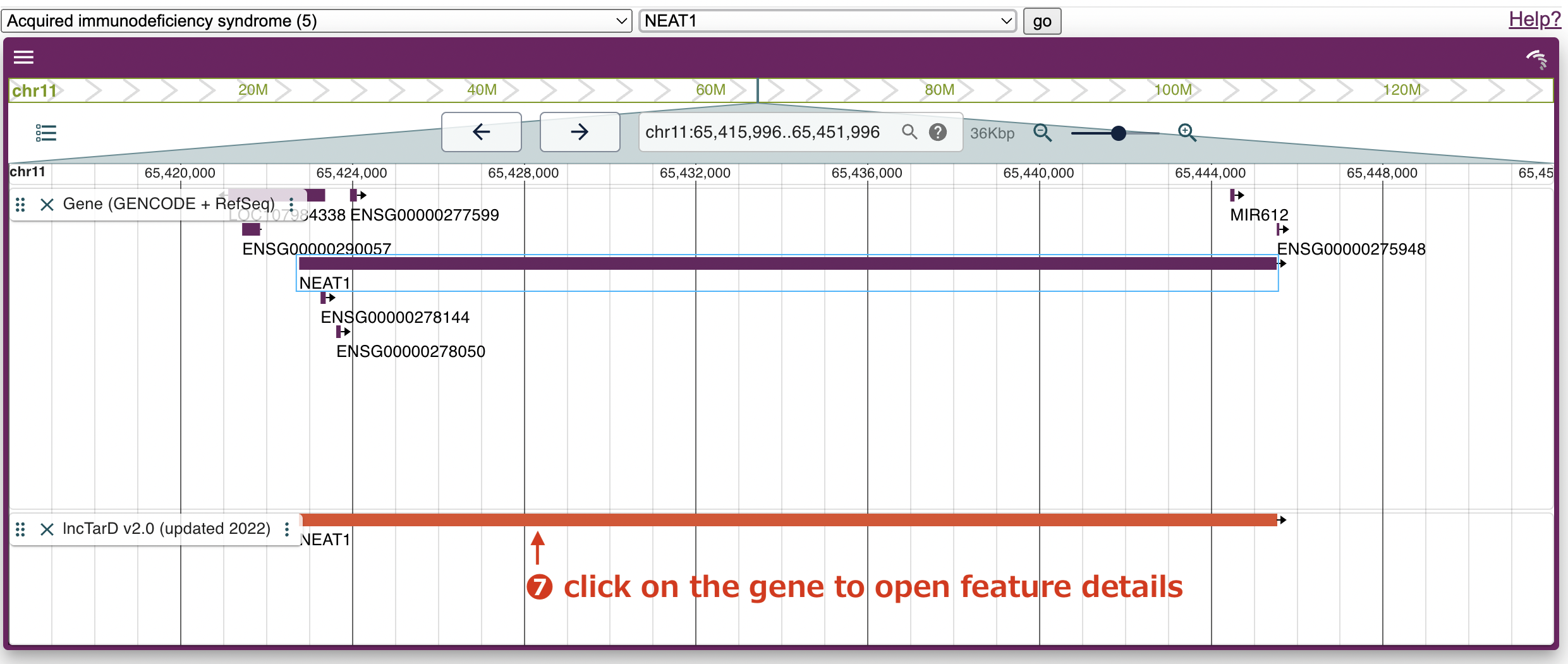
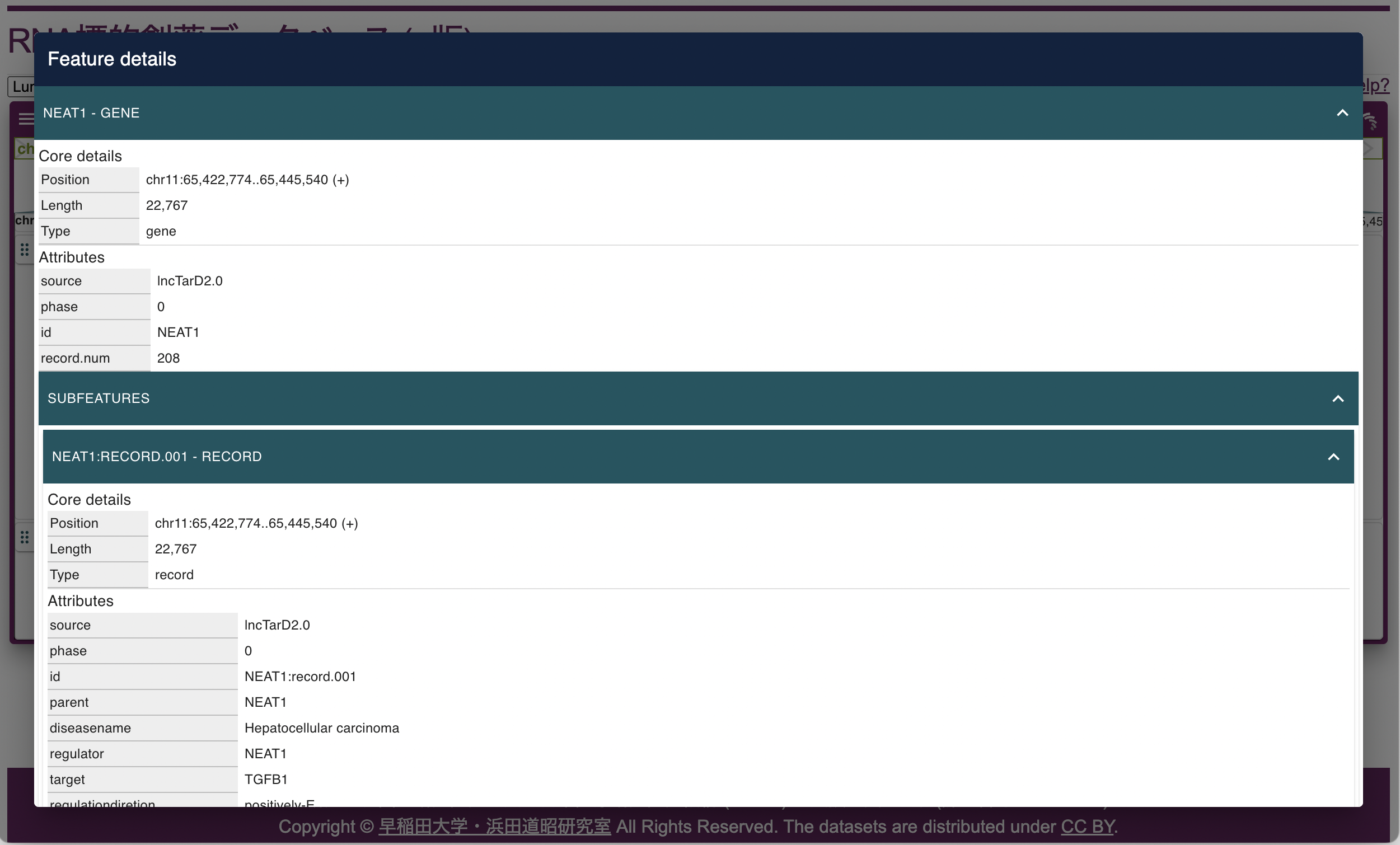
Table of registered tracks
| Group | Track | Description |
|---|---|---|
| Updates (data newly added in 2025, under adjustment) | GENCODE v48 (basic) | Basic Gene Annotation Set from GENCODE Version 48 (Ensembl 114) |
| GENCODE v48 (comprehensive) | Comprehensive Gene Annotation Set from GENCODE Version 48 (Ensembl 114) | |
| RNAmotifProb (Kawai Lab) | Evaluation of the affinity between RNA structural motifs and compounds (credit: Kawai Lab) | |
| refTSS_v4.1 | Reference dataset of transcription start sites obtained from refTSS v4.1 (https://reftss.riken.jp/) | |
| TargetScan_hg38_broadConsFam_consSite | Prediction of miRNA targets by TargetScan (release 8.0). Conserved target sites of broadly conserved miRNA families. High-confidence evolutionary conserved interactions. (source: https://www.targetscan.org/vert_80/vert_80_data_download/All_Target_Locations.hg19.bed.zip, converted to hg38 coordinates with liftOver) | |
| TargetScan_hg38_broadConsFam_nonConsSite | Prediction of miRNA targets by TargetScan (release 8.0). Non-conserved target sites of broadly conserved miRNA families. Potential species-specific targets of conserved miRNAs. (source: https://www.targetscan.org/vert_80/vert_80_data_download/All_Target_Locations.hg19.bed.zip, converted to hg38 coordinates with liftOver) | |
| TargetScan_hg38_consFam_consSite | Prediction of miRNA targets by TargetScan (release 8.0). Conserved target sites of conserved miRNA families. Slightly broader set than Broad’s definition. (source: https://www.targetscan.org/vert_80/vert_80_data_download/All_Target_Locations.hg19.bed.zip, converted to hg38 coordinates with liftOver) | |
| TargetScan_hg38_consFam_nonConsSite | Prediction of miRNA targets by TargetScan (release 8.0). Non-conserved target sites of conserved miRNA families. Possibly functional but not evolutionarily conserved. (source: https://www.targetscan.org/vert_80/vert_80_data_download/All_Target_Locations.hg19.bed.zip, converted to hg38 coordinates with liftOver) | |
| TargetScan_hg38_nonConsFam_consSite | Prediction of miRNA targets by TargetScan (release 8.0). Conserved target sites of non-conserved miRNA families. Rare but may represent emerging regulatory roles. (source: https://www.targetscan.org/vert_80/vert_80_data_download/All_Target_Locations.hg19.bed.zip, converted to hg38 coordinates with liftOver) | |
| TargetScan_hg38_nonConsFam_nonConsSite | Prediction of miRNA targets by TargetScan (release 8.0). Non-conserved target sites of non-conserved miRNA families. Lowest confidence, may reflect noise or species-specific regulation. (source: https://www.targetscan.org/vert_80/vert_80_data_download/All_Target_Locations.hg19.bed.zip, converted to hg38 coordinates with liftOver) | |
| TargetScan_hg38_otherFam_consSite | Prediction of miRNA targets by TargetScan (release 8.0). Conserved target sites of miRNAs not classified into the main families. May include less-characterized or novel miRNAs. (source: https://www.targetscan.org/vert_80/vert_80_data_download/All_Target_Locations.hg19.bed.zip, converted to hg38 coordinates with liftOver) | |
| TargetScan_hg38_otherFam_nonConsSite | Prediction of miRNA targets by TargetScan (release 8.0). Non-conserved target sites of other miRNAs outside standard family definitions. Lower confidence or potentially novel functions. (source: https://www.targetscan.org/vert_80/vert_80_data_download/All_Target_Locations.hg19.bed.zip, converted to hg38 coordinates with liftOver) | |
| Gene annotation | Gene (GENCODE + RefSeq) | Gene coordinates merged from GENCODE v42 (comprehensive) and NCBI RefSeq (2021-12-08), transcript data removed, to provide a simplified track for browsing gene positions. |
| GENCODE v42 (comprehensive) | Comprehensive Gene Annotation Set from GENCODE Version 42 (Ensembl 108) | |
| GENCODE v42 (basic) | Basic Gene Annotation Set from GENCODE Version 42 (Ensembl 108) | |
| NCBI RefSeq (2021-12-08) | Human protein-coding and non-protein-coding genes taken from the NCBI RNA reference sequences collection (RefSeq) | |
| MiTranscriptome v2 | MiTranscriptome is a catalog of human long poly-adenylated RNA transcripts derived from computational analysis of high-throughput RNA sequencing (RNA-seq) data from over 6,500 samples spanning diverse cancer and tissue types. Among the complete catalog of over 91,000 genes, the majority are previously uncharacterized lncRNAs. Gene expression analysis of the transcripts revealed numerous cancer-specific and lineage-specific RNAs. (source:https://www.mitranscriptome.org/, converted to hg38 coordinates with liftOver)) | |
| NONCODE v6 | NONCODE is an integrated knowledge database dedicated to non-coding RNAs (excluding tRNAs and rRNAs) (source:http://www.noncode.org/) | |
| SIST v1 | For internal testing, will be removed in the official release. | |
| LNCipedia v5.2 | LNCipedia is a public database for long non-coding RNA (lncRNA) sequence and annotation. The current release contains 127,802 transcripts and 56,946 genes. (source:https://lncipedia.org/)) | |
| LncBook v2.0 | LncBook accommodates a high-quality collection of 95,243 human lncRNA genes and 323,950 lncRNA transcripts, and incorporates their abundant annotations at different omics levels, thereby enabling users to decipher functional signatures of lncRNAs in human diseases and different biological contexts. (source:https://ngdc.cncb.ac.cn/lncbook/home)) | |
| Disease-associated lncRNAs | lncTarD v2.0 (updated 2022) | LncTarD is a comprehensive resource which aims to provide experimentally supported key lncRNA-target regulations, their influenced functions and lncRNA-mediated regulatory mechanisms in human diseases and several web-based tools based on single-cell RNA-seq and RNA-seq/microarray data. LncTarD can serve as a timely and valuable resource for understanding functions and molecular mechanisms of lncRNA deregulation in disease pathogenesis, which will help to identify novel and sensitive biomarkers and therapeutic targets in human diseases. (source:https://lnctard.bio-database.com/)) |
| LncRNADisease v2 (updated 2018) | Long non-coding RNAs (lncRNAs) are an important category of non-coding RNAs (ncRNAs) which range from 200 nucleotides to multiple kilobases in length, with little or no protein-coding capacity. Circular RNAs (circRNAs) are widely expressed in diverse eukaryotic species and are characterized by covalently closed RNA loops through backsplicing events. Increasing evidence has highlighted the critical roles of lncRNAs and circRNAs in plenty of diseases development and progression. Here, we have updated the LncRNADisease database to version 3.0 by integrating comprehensive experimentally supported and predicted ncRNA-disease associations curated from manual literatures and other resources. The new developments in LncRNADisease v3.0 include (I) integrating over 2-fold experimentally supported ncRNA-disease associations enhancement compare to the previous version; (II) integrating circRNA-disease associations; (II) significantly increasing the causative associations between ncRNAs and diseases; (III) mapping disease name to the Disease Ontology and Medical Subject Headings (MeSH). (source:http://www.rnanut.net/lncrnadisease/)) | |
| Semi-extractable RNAs (Hirose Lab) | Merged.gtf.v1 | For internal testing, will be removed in the official release. |
| Merged.gtf.v2 | For internal testing, will be removed in the official release. | |
| A549 (Influenza virus infection) | Semi-extractable RNA-seq of A549 cells (Influenza virus infection) | |
| A549 (Doxorubicin treatment) | Semi-extractable RNA-seq of A549 cells (Doxorubicin treatment) | |
| HeLa | Semi-extractable RNA-seq of HeLa cells | |
| HAP1 | Semi-extractable RNA-seq of HAP1 cells | |
| HEK | Semi-extractable RNA-seq of HEK cells | |
| WT-A10 | Semi-extractable RNA-seq of WT-A10 cells | |
| RNA-RNA interaction | ES (RISE) | Transcriptome-wide RNA-RNA interactions (PARIS, MARIO, SPLASH, LIGR-seq) of ES cells adapted from RISE (http://rise.life.tsinghua.edu.cn/downloads.html) on Nov 13, 2022 |
| HeLa (RISE) | Transcriptome-wide RNA-RNA interactions (PARIS, MARIO, SPLASH, LIGR-seq) of HeLa cells adapted from RISE (http://rise.life.tsinghua.edu.cn/downloads.html) on Nov 13, 2022 | |
| HEK293T (RISE) | Transcriptome-wide RNA-RNA interactions (PARIS, MARIO, SPLASH, LIGR-seq) of HEK293T cells adapted from RISE (http://rise.life.tsinghua.edu.cn/downloads.html) on Nov 13, 2022 | |
| Lymphoblastoid (RISE) | Transcriptome-wide RNA-RNA interactions (PARIS, MARIO, SPLASH, LIGR-seq) of Lymphoblastoid cells adapted from RISE (http://rise.life.tsinghua.edu.cn/downloads.html) on Nov 13, 2022 | |
| RNA-Ligand interaction | RNALigands (in Silico) | Predicted by RNALigands based on RNA-ligand interactions in PDB, R-BIND, and Inforna (RNA secondary structures were predicted by LinearFold with default parameters). Because of limited computational resources, only partial gene predictions are available. Further optimization of the RNALigands algorithm is needed to enable genome-wide prediction. |
| Drug Target Discovery | ScanFold (win=60, local minima) | ScanFold was used to calculate the thermodynamic Z-score of RNA sequences, which represents the stability of the secondary structure in a 60-base region centered on each base. A negative Z-score indicates higher-than-expected RNA thermodynamic stability. Complete dataset pending upload. |
| ScanFold (win=90, local minima) | ScanFold was used to calculate the thermodynamic Z-score of RNA sequences, which represents the stability of the secondary structure in a 90-base region centered on each base. A negative Z-score indicates higher-than-expected RNA thermodynamic stability. Complete dataset pending upload. | |
| ScanFold (win=120, local minima) | ScanFold was used to calculate the thermodynamic Z-score of RNA sequences, which represents the stability of the secondary structure in a 120-base region centered on each base. A negative Z-score indicates higher-than-expected RNA thermodynamic stability. Complete dataset pending upload. | |
| RNALigands (win=200) | ScanFold was used to calculate the thermodynamic Z-score of RNA sequences, which represents the stability of the secondary structure in a 200-base region centered on each base. A negative Z-score indicates higher-than-expected RNA thermodynamic stability. Complete dataset pending upload. | |
| RBP-binding (FUS) | For internal testing, will be removed in the official release. | |
| RNA G-quadruplex | For internal testing, will be updated in the official release. | |
| RNAz v2.1.1 | RNAz detects stable and conserved RNA secondary structures in multiple sequence alignments. Complete dataset pending upload. | |
| NEAT1_2 triple helix | For internal testing, will be removed in the official release. | |
| RNA-FM | Shannon entropy derived from the logits of masked language modeling of RNA-FM for each nucleotide at various positions. The logits are approximated using the pseudo-perplexity method. Smaller values indicate positions which are easier for RNA-FM to estimate from a region around the positions. Complete dataset pending upload. | |
| Subcellular Localization | APEX-seq (HEK) | Atlas of Subcellular RNA Localization Revealed by APEX-seq, a method for RNA sequencing based on direct proximity labeling of RNA using the peroxidase enzyme APEX2. (data source: GSE116008) |
| RNA Modification | m6A-Atlas v2.0 | m6A-Atlas database to provide a more comprehensive view of m6A landscape. (source: http://rnamd.org/m6a/) |
| other modifications | m6A-Atlas database to provide a more comprehensive view of m6A landscape. (source: http://rnamd.org/m6a/, hg38_otherMod track) | |
| RNA-binding Proteins | ENCODE RBPs (K562) | IDR peaks from eCLIP of RNA-binding proteins in K562 cells |
| ENCODE RBPs (HepG2) | IDR peaks from eCLIP of RNA-binding proteins in HepG2 cells | |
| Repeat | RepeatMasker | Interspersed repeats and low complexity DNA sequence that predicted by RepeatMasker |
| RNA structurome | K562 (DMS, Rouskin et al, Nature 2014) | Genome-wide probing of RNA structurome in K562 cells based on in vivo modification with dimethyl sulfate (DMS), which reacts with unpaired adenine and cytosine residues9, followed by deep sequencing to monitor modifications. |
| FBL (DMS, Rouskin et al, Nature 2014) | Genome-wide probing of RNA structurome in FBL cells based on in vivo modification with dimethyl sulfate (DMS), which reacts with unpaired adenine and cytosine residues9, followed by deep sequencing to monitor modifications. | |
| HEK293 (icSHAPE, Sun et al, Nature Structural & Molecular Biology 2019) | Genome-wide probing of RNA structurome in HEK293 cells based on in vivo click selective 2'-hydroxyl acylation and profiling experiment (icSHAPE) technology | |
| HEK293 (PARIS, Lu et al, Cell 2016) | RNA duplex map of HEK293 cells determined by PARIS, a method based on reversible psoralen crosslinking for global mapping of RNA duplexes with near base-pair resolution. | |
| Rfam 14.9 (Nov 2022, 4108 families) | The Rfam database is a collection of RNA families, each represented by multiple sequence alignments, consensus secondary structures and covariance models | |
| Expression (RNA-seq) | The Cancer Genome Atlas (TCGA) | The Cancer Genome Atlas (TCGA), a landmark cancer genomics program, molecularly characterized over 20,000 primary cancer and matched normal samples spanning 33 cancer types. |
| The Genotype-Tissue Expression (GTEx) | The Genotype-Tissue Expression (GTEx) is a comprehensive public resource for researchers studying tissue and cell-specific gene expression. | |
| Expression (MoriiLab2025,Organoid) | F4186_LO11_P3_IPF-RCx10_Ramda_1 | LO11, Cytokine to alveolar, Ramda |
| F4186_LO11_P3_IPF-RCx10_Ramda_2 | LO11, Cytokine to alveolar, Ramda | |
| F4186_LO11_P3_NC_Ramda_1 | LO11, Negative Control (Cytokine free), Ramda | |
| F4186_LO11_P3_NC_Ramda_2 | LO11, Negative Control (Cytokine free), Ramda | |
| F4186_LO8_P3_IPF-RCx10_Ramda | LO8, Cytokine to alveolar, Ramda | |
| F4186_LO8_P3_NC_Ramda | LO8, Negative Control (Cytokine free), Ramda | |
| F4186_LO11_P3_IPF-RCx10_Smart_1 | LO11, Cytokine to alveolar, Smart | |
| F4186_LO11_P3_IPF-RCx10_Smart_2 | LO11, Cytokine to alveolar, Smart | |
| F4186_LO11_P3_NC_Smart_1 | LO11, Negative Control (Cytokine free), Smart | |
| F4186_LO11_P3_NC_Smart_2 | LO11, Negative Control (Cytokine free), Smart | |
| F4186_LO8_P3_IPF-RCx10_Smart | LO8, Cytokine to alveolar, Smart | |
| F4186_LO8_P3_NC_Smart | LO8, Negative Control (Cytokine free), Smart | |
| F5704_LO14_1-4_no1_Ramda | LO14, MIR205HG knocked-down airway, Ramda | |
| F5704_LO14_5-8_no1_Ramda | LO14, MIR205HG knocked-down airway, Ramda | |
| F5704_LO14_1-4_no2_Ramda | LO14, MIR205HG knocked-down airway, Ramda | |
| F5704_LO14_5-8_no2_Ramda | LO14, MIR205HG knocked-down airway, Ramda | |
| F5704_LO14_NV_no1_Ramda | LO14, Negative Control (MIR205HG KD), Ramda | |
| F5704_LO14_NV_no2_Ramda | LO14, Negative Control (MIR205HG KD), Ramda | |
| F5704_LO18_1-4_no1_Ramda | LO18, MIR205HG knocked-down airway, Ramda | |
| F5704_LO18_5-8_no1_Ramda | LO18, MIR205HG knocked-down airway, Ramda | |
| F5704_LO18_NV_no1_Ramda | LO18, Negative Control (MIR205HG KD), Ramda | |
| F5704_LO14_1-4_no1_Smart | LO14, MIR205HG knocked-down airway, Smart | |
| F5704_LO14_5-8_no1_Smart | LO14, MIR205HG knocked-down airway, Smart | |
| F5704_LO14_1-4_no2_Smart | LO14, MIR205HG knocked-down airway, Smart | |
| F5704_LO14_5-8_no2_Smart | LO14, MIR205HG knocked-down airway, Smart | |
| F5704_LO14_NV_no1_Smart | LO14, Negative Control (MIR205HG KD), Smart | |
| F5704_LO14_NV_no2_Smart | LO14, Negative Control (MIR205HG KD), Smart | |
| F5704_LO18_1-4_no1_Smart | LO18, MIR205HG knocked-down airway, Smart | |
| F5704_LO18_5-8_no1_Smart | LO18, MIR205HG knocked-down airway, Smart | |
| F5704_LO18_NV_no1_Smart | LO18, Negative Control (MIR205HG KD), Smart | |
| F6340_LO11_NV_1_Ramda | LO11, Negative Control (MIR205HG OE), Ramda | |
| F6340_LO11_OE_1_Ramda | LO11, MIR205HG overexpressing alveolar, Ramda | |
| F6340_LO12_OE_no1_Ramda | LO12, MIR205HG overexpressing alveolar, Ramda | |
| F6340_LO12_OE_no2_Ramda | LO12, MIR205HG overexpressing alveolar, Ramda | |
| F6340_LO12_NV_no1_Ramda | LO12, Negative Control (MIR205HG OE), Ramda | |
| F6340_LO12_NV_no2_Ramda | LO12, Negative Control (MIR205HG OE), Ramda | |
| F6340_LO8_NV_1_Ramda | LO8, Negative Control (MIR205HG OE), Ramda | |
| F6340_LO8_NV_2_Ramda | LO8, Negative Control (MIR205HG OE), Ramda | |
| F6340_LO8_OE_1_Ramda | LO8, MIR205HG overexpressing alveolar, Ramda | |
| F6340_LO8_OE_2_Ramda | LO8, MIR205HG overexpressing alveolar, Ramda | |
| F6340_LO12_OE_no1_Smart | LO12, MIR205HG overexpressing alveolar, Smart | |
| F6340_LO12_OE_no2_Smart | LO12, MIR205HG overexpressing alveolar, Smart | |
| F6340_LO12_NV_no1_Smart | LO12, Negative Control (MIR205HG OE), Smart | |
| F6340_LO12_NV_no2_Smart | LO12, Negative Control (MIR205HG OE), Smart | |
| F6531_LO12_Alveolar_Ramda | LO12, Alveolar organoid, Ramda | |
| F6531_LO13_Alveolar_Ramda | LO13, Alveolar organoid, Ramda | |
| F6531_LO16_Airway_Ramda | LO16, Airway organoid, Ramda | |
| F6531_LO17_P2_alveolar_Ramda | LO17, Alveolar organoid at passage 2, Ramda | |
| F6531_LO18_Airway_Ramda | LO18, Airway organoid, Ramda | |
| F6531_LO19_Airway_Ramda | LO19, Airway organoid, Ramda | |
| F6531_LO21_P2_airway_Ramda | LO21, Airway organoid at passage 2, Ramda | |
| F6531_LO23_P2_alveolar_Ramda | LO23, Alveolar organoid at passage 2, Ramda | |
| F6531_LO24_P0_airway_Ramda | LO24, Airway organoid, Ramda | |
| F6531_LO12_Alveolar_Smart | LO12, Alveolar organoid, Smart | |
| F6531_LO13_Alveolar_Smart | LO13, Alveolar organoid, Smart | |
| F6531_LO16_Airway_Smart | LO16, Airway organoid, Smart | |
| F6531_LO17_P2_alveolar_Smart | LO17, Alveolar organoid at passage 2, Smart | |
| F6531_LO18_Airway_Smart | LO18, Airway organoid, Smart | |
| F6531_LO19_Airway_Smart | LO19, Airway organoid, Smart | |
| F6531_LO21_P2_airway_Smart | LO21, Airway organoid at passage 2, Smart | |
| F6531_LO23_P2_alveolar_Smart | LO23, Alveolar organoid at passage 2, Smart | |
| F6531_LO24_P0_airway_Smart | LO24, Airway organoid, Smart | |
| F6909_LO11_6hr_IPF_RCx10_Ramda | LO11, Cytokine to alveolar, Ramda | |
| F6909_LO11_6hr_NC_Ramda | LO11, Negative Control (Cytokine free), Ramda | |
| F6909_LO11_day1_IPF_RCx10_Ramda | LO11, Cytokine to alveolar, Ramda | |
| F6909_LO11_day1_NC_Ramda | LO11, Negative Control (Cytokine free), Ramda | |
| F6909_LO11_day2_IPF_RCx10_Ramda | LO11, Cytokine to alveolar, Ramda | |
| F6909_LO11_day2_NC_Ramda | LO11, Negative Control (Cytokine free), Ramda | |
| F6909_LO11_day4_IPF_RCx10_Ramda | LO11, Cytokine to alveolar, Ramda | |
| F6909_LO11_day4_NC_Ramda | LO11, Negative Control (Cytokine free), Ramda | |
| F6909_LO23_day12_IPF_RCx10_Ramda | LO23, Cytokine to alveolar, Ramda | |
| F6909_LO23_day12_NC_Ramda | LO23, Negative Control (Cytokine free), Ramda | |
| F6909_LO23_day4_IPF_RCx10_Ramda | LO23, Cytokine to alveolar, Ramda | |
| F6909_LO23_day4_NC_Ramda | LO23, Negative Control (Cytokine free), Ramda | |
| F6909_LO23_day8_IPF_RCx10_Ramda | LO23, Cytokine to alveolar, Ramda | |
| F6909_LO23_day8_NC_Ramda | LO23, Negative Control (Cytokine free), Ramda | |
| F6909_LO11_6hr_IPF_RCx10_Smart | LO11, Cytokine to alveolar, Smart | |
| F6909_LO11_6hr_NC_Smart | LO11, Negative Control (Cytokine free), Smart | |
| F6909_LO11_day1_IPF_RCx10_Smart | LO11, Cytokine to alveolar, Smart | |
| F6909_LO11_day1_NC_Smart | LO11, Negative Control (Cytokine free), Smart | |
| F6909_LO11_day2_IPF_RCx10_Smart | LO11, Cytokine to alveolar, Smart | |
| F6909_LO11_day2_NC_Smart | LO11, Negative Control (Cytokine free), Smart | |
| F6909_LO11_day4_IPF_RCx10_Smart | LO11, Cytokine to alveolar, Smart | |
| F6909_LO11_day4_NC_Smart | LO11, Negative Control (Cytokine free), Smart | |
| F6909_LO23_day12_IPF_RCx10_Smart | LO11, Cytokine to alveolar, Smart | |
| F6909_LO23_day12_NC_Smart | LO23, Negative Control (Cytokine free), Smart | |
| F6909_LO23_day4_IPF_RCx10_Smart | LO23, Cytokine to alveolar, Smart | |
| F6909_LO23_day4_NC_Smart | LO23, Negative Control (Cytokine free), Smart | |
| F6909_LO23_day8_IPF_RCx10_Smart | LO23, Cytokine to alveolar, Smart | |
| F6909_LO23_day8_NC_Smart | LO23, Negative Control (Cytokine free), Smart | |
| F7802_LO8P4_6hr_IPF_RCx1_Ramda | LO8, Cytokine to alveolar (diluted cytokine), Ramda | |
| F7802_LO8P4_day1_IPF_RCx1_Ramda | LO8, Cytokine to alveolar (diluted cytokine), Ramda | |
| F7802_LO8P4_day2_IPF_RCx1_Ramda | LO8, Cytokine to alveolar (diluted cytokine), Ramda | |
| F7802_LO8P4_day4_IPF_RCx1_Ramda | LO8, Cytokine to alveolar (diluted cytokine), Ramda | |
| F7802_LO8P4_day8_IPF_RCx1_Ramda | LO8, Cytokine to alveolar (diluted cytokine), Ramda | |
| F7802_LO8P4_day12_IPF_RCx1_Ramda | LO8, Cytokine to alveolar (diluted cytokine), Ramda | |
| F7802_LO8P4_6hr_NC_Ramda | LO8, Negative Control (Cytokine free), Ramda | |
| F7802_LO8P4_day1_NC_Ramda | LO8, Negative Control (Cytokine free), Ramda | |
| F7802_LO8P4_day2_NC_Ramda | LO8, Negative Control (Cytokine free), Ramda | |
| F7802_LO8P4_day4_NC_Ramda | LO8, Negative Control (Cytokine free), Ramda | |
| F7802_LO8P4_day8_NC_Ramda | LO8, Negative Control (Cytokine free), Ramda | |
| F7802_LO8P4_day12_NC_Ramda | LO8, Negative Control (Cytokine free), Ramda | |
| F7802_LO8P4_6hr_IPF_RCx1_Smart | LO8, Cytokine to alveolar (diluted cytokine), Smart | |
| F7802_LO8P4_day1_IPF_RCx1_Smart | LO8, Cytokine to alveolar (diluted cytokine), Smart | |
| F7802_LO8P4_day2_IPF_RCx1_Smart | LO8, Cytokine to alveolar (diluted cytokine), Smart | |
| F7802_LO8P4_day4_IPF_RCx1_Smart | LO8, Cytokine to alveolar (diluted cytokine), Smart | |
| F7802_LO8P4_day8_IPF_RCx1_Smart | LO8, Cytokine to alveolar (diluted cytokine), Smart | |
| F7802_LO8P4_day12_IPF_RCx1_Smart | LO8, Cytokine to alveolar (diluted cytokine), Smart | |
| F7802_LO8P4_6hr_NC_Smart | LO8, Negative Control (Cytokine free), Smart | |
| F7802_LO8P4_day1_NC_Smart | LO8, Negative Control (Cytokine free), Smart | |
| F7802_LO8P4_day2_NC_Smart | LO8, Negative Control (Cytokine free), Smart | |
| F7802_LO8P4_day4_NC_Smart | LO8, Negative Control (Cytokine free), Smart | |
| F7802_LO8P4_day8_NC_Smart | LO8, Negative Control (Cytokine free), Smart | |
| F7802_LO8P4_day12_NC_Smart | LO8, Negative Control (Cytokine free), Smart | |
| F7803_LO11P5_6hr_IPF_RCx1_Ramda | LO11, Cytokine to alveolar (diluted cytokine), Ramda | |
| F7803_LO11P5_day1_IPF_RCx1_Ramda | LO11, Cytokine to alveolar (diluted cytokine), Ramda | |
| F7803_LO11P5_day2_IPF_RCx1_Ramda | LO11, Cytokine to alveolar (diluted cytokine), Ramda | |
| F7803_LO11P5_day4_IPF_RCx1_Ramda | LO11, Cytokine to alveolar (diluted cytokine), Ramda | |
| F7803_LO11P5_day8_IPF_RCx1_Ramda | LO11, Cytokine to alveolar (diluted cytokine), Ramda | |
| F7803_LO11P5_day12_IPF_RCx1_Ramda | LO11, Cytokine to alveolar (diluted cytokine), Ramda | |
| F7803_LO11P5_6hr_NC_Ramda | LO11, Negative Control (Cytokine free), Ramda | |
| F7803_LO11P5_day1_NC_Ramda | LO11, Negative Control (Cytokine free), Ramda | |
| F7803_LO11P5_day2_NC_Ramda | LO11, Negative Control (Cytokine free), Ramda | |
| F7803_LO11P5_day4_NC_Ramda | LO11, Negative Control (Cytokine free), Ramda | |
| F7803_LO11P5_day8_NC_Ramda | LO11, Negative Control (Cytokine free), Ramda | |
| F7803_LO11P5_day12_NC_Ramda | LO11, Negative Control (Cytokine free), Ramda | |
| F7803_LO11P5_6hr_IPF_RCx1_Smart | LO11, Cytokine to alveolar (diluted cytokine), Smart | |
| F7803_LO11P5_day1_IPF_RCx1_Smart | LO11, Cytokine to alveolar (diluted cytokine), Smart | |
| F7803_LO11P5_day2_IPF_RCx1_Smart | LO11, Cytokine to alveolar (diluted cytokine), Smart | |
| F7803_LO11P5_day4_IPF_RCx1_Smart | LO11, Cytokine to alveolar (diluted cytokine), Smart | |
| F7803_LO11P5_day8_IPF_RCx1_Smart | LO11, Cytokine to alveolar (diluted cytokine), Smart | |
| F7803_LO11P5_day12_IPF_RCx1_Smart | LO11, Cytokine to alveolar (diluted cytokine), Smart | |
| F7803_LO11P5_6hr_NC_Smart | LO11, Negative Control (Cytokine free), Smart | |
| F7803_LO11P5_day1_NC_Smart | LO11, Negative Control (Cytokine free), Smart | |
| F7803_LO11P5_day2_NC_Smart | LO11, Negative Control (Cytokine free), Smart | |
| F7803_LO11P5_day4_NC_Smart | LO11, Negative Control (Cytokine free), Smart | |
| F7803_LO11P5_day8_NC_Smart | LO11, Negative Control (Cytokine free), Smart | |
| F7803_LO11P5_day12_NC_Smart | LO11, Negative Control (Cytokine free), Smart | |
| F7804_LO11_Entinostat_1uM_Ramda | LO11, HDAC inhibitor to alveolar, Ramda | |
| F7804_LO11_Entinostat_5uM_Ramda | LO11, HDAC inhibitor to alveolar, Ramda | |
| F7804_LO11_NC_Ramda | LO11, Negative Control (HDAC inhibitor), Ramda | |
| F7804_LO11_Entinostat_1uM_Smart | LO11, HDAC inhibitor to alveolar, Smart | |
| F7804_LO11_Entinostat_5uM_Smart | LO11, HDAC inhibitor to alveolar, Smart | |
| F7804_LO11_NC_Smart | LO11, Negative Control (HDAC inhibitor), Smart | |
| F8155_LO19_Control_72h_Ramda | LO19, Negative Control (DQzG), Ramda | |
| F8155_LO19_DQzG_5uM_48h_Ramda | LO19, DQzG to airway, Ramda | |
| F8155_LO19_DQzG_5uM_72h_Ramda | LO19, DQzG to airway, Ramda |